

As global demand for organic and bio-based fertilizers continues to grow, many producers are shifting from small workshops to large-scale biofertilizer production lines. Among various granulation technologies, the rotary drum granulation line has become one of the most widely adopted solutions for high-capacity biofertilizer manufacturing due to its stable output, continuous operation, and strong adaptability to different organic materials.
A large-scale rotary drum granulation system is often referred to as a drum granulator fertilizer production line, biofertilizer pellet production plant, or industrial organic fertilizer granulation line.
What Is a Rotary Drum Granulation Line?
A rotary drum granulation line uses a rotating cylindrical drum to agglomerate powdered organic materials into uniform fertilizer granules. During rotation, materials are mixed, rolled, and bonded together with controlled moisture and binders, forming round and dense biofertilizer pellets.
This type of production line is suitable for capacities ranging from 10 t/h to over 30 t/h, making it ideal for medium and large fertilizer manufacturers.
Typical Configuration of a Large Biofertilizer Drum Granulation Line
A complete large-scale rotary drum biofertilizer production line usually includes:
- Raw material crushing system
- Composting and fermentation section
- Batching and mixing equipment
- Rotary drum granulator (core machine)
- Rotary drum dryer and cooler
- Screening machine for size classification
- Coating machine for improved granule quality
- Automatic packing system
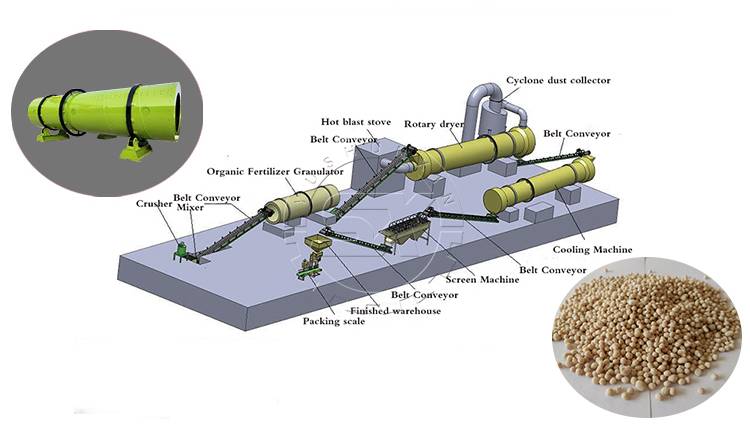
This integrated design ensures smooth material flow, high production efficiency, and consistent fertilizer quality. Inquiry YUSHUNXIN to customize your machine.
Advantages of Drum Granulation for Biofertilizer Production
Compared with disc granulation or roller compaction, rotary drum granulation offers several advantages in large-scale biofertilizer plants:
- Continuous and stable production for high output
- Strong adaptability to various organic raw materials such as manure compost, digestate, and agricultural waste
- Uniform granule size and good mechanical strength
- Easy integration with drying and cooling systems
- Lower labor intensity in automated fertilizer factories
These benefits make drum granulation technology a preferred choice for industrial biofertilizer production.
Raw Materials Suitable for Drum Granulation
A rotary drum granulation line can process a wide range of fermented organic materials, including:
- Cow manure compost
- Chicken manure fertilizer
- Pig manure organic compost
- Agricultural waste and crop residues
- Bio-organic fertilizer mixtures with additives
Proper moisture control and material preparation are key to achieving stable granulation performance.
Applications and Market Value
Granulated biofertilizer products offer better storage stability, reduced dust, and higher market acceptance compared with powdered fertilizers. Large-scale drum granulation lines enable producers to meet bulk market demand while maintaining consistent product quality.
This makes them suitable for commercial fertilizer plants, regional distributors, and export-oriented biofertilizer manufacturers. Learn more!
Conclusion
A large-scale rotary drum granulation line for biofertilizer manufacturing is a mature and reliable solution for producers seeking high capacity, automation, and long-term operational stability. With proper system design and equipment selection, drum granulation technology can significantly enhance production efficiency and product competitiveness in the organic fertilizer market. If you need a business plan, welcome to visit: https://www.biofertilizerproduction.com/product/drum-pelletizer-in-biofertilizer-production-project/