

Choosing the right soluble raw materials is the foundation of producing stable and nutrient-rich liquid NPK fertilizers. Whether you are running a small fertilizer workshop or planning a complete liquid NPK fertilizer production line, ingredient solubility, purity, and compatibility directly influence product clarity, nutrient concentration, and long-term storage performance. Below is a practical guide to the most commonly used water-soluble N, P, and K sources, along with equipment considerations for efficient processing.
1. Highly Soluble Nitrogen Materials
For nitrogen, manufacturers typically rely on ingredients with fast dissolution rates to ensure a uniform liquid blend:
- Urea – the most widely used N source with excellent solubility.
- Ammonium nitrate – delivers strong nitrogen availability for foliar or drip systems.
- Calcium ammonium nitrate (CAN) – often used when crops need supplemental calcium.
These N materials dissolve easily in mixing tanks, reducing sediment formation and improving consistency in liquid N fertilizer production. Learn more!
2. Phosphorus Sources Suitable for Liquid Formulations
Phosphorus can be more challenging because many phosphate salts have low solubility. The following options are common in liquid NPK formulations:
- Monoammonium phosphate (MAP)
- Monopotassium phosphate (MKP)
- Phosphoric acid (industrial grade or food grade)
Liquid manufacturers often prefer phosphoric acid for its high solubility and ability to adjust pH during blending. MAP and MKP are ideal when a balanced N-K-P ratio is required.
3. Potassium Additives for Clear Liquid Blends
Potassium plays an essential role in boosting crop resistance and improving yield. Popular K materials for liquid potassium fertilizer include:
- Potassium nitrate (NOP) – highly soluble and compatible with most N sources.
- Potassium sulfate (SOP) – suitable for chloride-sensitive crops.
- Potassium carbonate – dissolves rapidly and helps regulate pH levels.
The selection often depends on crop type and salinity requirements.
4. Equipment Requirements for Stable Liquid Fertilizer Production
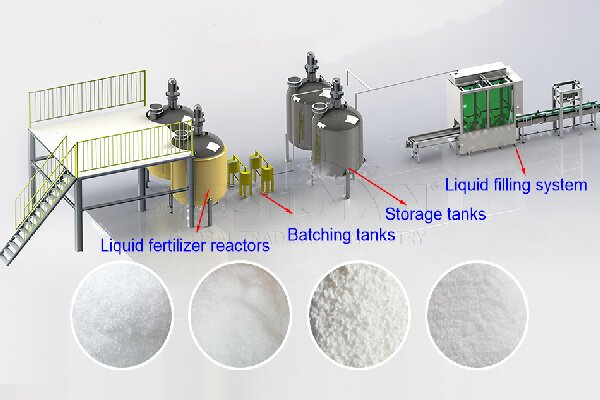
Beyond choosing the right raw materials, consistent quality relies heavily on suitable liquid fertilizer processing equipment:
- Dissolving tanks / mixing reactors with heating and agitation for quick solubilization
- Inline filters to remove insoluble impurities
- Storage reactors with pH control
- Pumps and pipelines designed for corrosion resistance
- Liquid fertilizer filling machines (semi-auto or fully automatic) for accurate packaging
For higher production volumes, a complete NPK liquid fertilizer production line integrates automated dosing, mixing, filtration, and filling to reduce labor and improve batch stability. If you need the liquid fertilizer making machine, feel free to consult YUSHUNXIN!
Conclusion
Selecting proper water-soluble raw materials—such as urea, MAP, phosphoric acid, and potassium nitrate—ensures efficient manufacturing of clear, nutrient-dense liquid NPK fertilizers. When paired with well-designed equipment like dissolution tanks, filtration units, and automated filling systems, producers can achieve consistent product quality and lower operational costs. If you need a business plan, welcome to visit: https://www.liquidfertilizerplants.com/products/npk-liquid-fertilizer-production-line/