

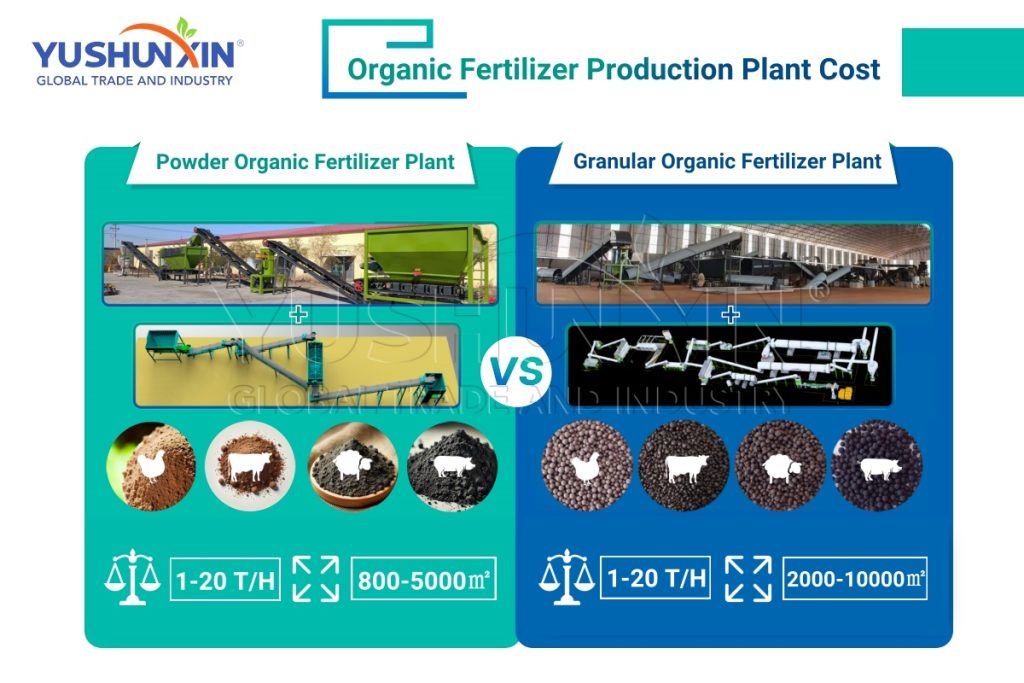
Organic fertilizer production plant cost often depends on one core link: granulation. A pelletizer, granulator, or pellet making machine determines how smoothly powder turns into stable granules, how much electricity each ton consumes, how many workers a line requires, and how often equipment stops for cleaning or repair. Therefore, pelletizing efficiency influences fertilizer plant setup cost and long-term fertilizer factory cost at the same time. A well-matched granulating process also stabilizes product size, moisture, and density, so the downstream drying, screening, and packing procedure runs with fewer interruptions. As a result, investors usually evaluate pelletizer efficiency as a direct driver of organic fertilizer plant cost and fertilizer manufacturing plant cost.
Which organic fertilizer raw materials support stable granulation and lower organic fertilizer production plant cost?
Different raw materials create different granulation difficulty, so raw material selection shapes pelletizer load, binder usage, and recycle ratio. Livestock manure such as chicken manure, cow dung, and pig manure often provides good organic content, yet these materials usually require composting preparation to control moisture and reduce stickiness. Plant-based inputs such as straw powder, rice husk powder, corn stalk powder, and bagasse powder often improve particle structure, so a pelletizer can form pellets with less internal friction. Industrial organic residues such as mushroom substrate, distillers grains, sugar filter mud, and palm fiber can also serve organic fertilizer manufacturing, but these materials often show wider moisture variation, so the granulating procedure needs stronger adaptability.
Mineral and functional additives also change pellet making behavior. Humic acid powder, biochar powder, bentonite, gypsum, and phosphate rock powder can improve granule hardness or reduce sticking, yet overdosing can increase dust and raise recycle. Consequently, raw material compatibility reduces organic fertilizer plant cost because stable powder preparation reduces pelletizer overload, lowers electric consumption, and decreases the number of off-spec granules that return for re-granulation.

How does pelletizer efficiency reduce electricity, binder, and labor portions of fertilizer manufacturing plant cost?
Pelletizer efficiency describes output per hour, qualified granule rate, and energy consumption per ton. A high-efficiency pelletizing machine typically produces more uniform pellets or particles, so the screening machine rejects fewer fines and oversized granules. That improvement reduces the internal return flow, so the same production line can reach a higher net capacity without adding another granulator or pelletizer. At the same time, stable granulation lowers binder consumption because the material forms granules faster and holds shape better. Lower binder consumption reduces both material cost and drying load, so rotary drying machine fuel or power costs decline.
Labor cost also connects to pelletizer performance. A pellet making machine that supports stable feeding and simple adjustment reduces operator intervention during granulating, ball making, and particle shaping. In addition, a pelletizer that resists clogging and supports quick cleaning reduces downtime, so the plant avoids overtime labor and avoids production losses. Therefore, pelletizer efficiency lowers organic fertilizer plant cost through electricity savings, reduced consumables, and fewer labor hours per ton.
Which pelletizer or granulator features influence downtime and maintenance, affecting fertilizer factory cost?
Maintenance and downtime often determine hidden organic fertilizer plant cost, especially for medium and large organic fertilizer production lines. A granulator design that controls heat buildup and reduces material adhesion improves continuous pelletizing performance, so the production process maintains stable throughput. Wear-resistant liners, reliable bearings, and balanced transmission also reduce frequent parts replacement, so spare-parts cost and service cost decline. A pelletizer with stable torque output supports dense pellet making when raw material bulk density changes, so the machinery avoids sudden overload trips that stop the full line.
Control and integration features also influence fertilizer manufacturing plant cost. A pelletizing machine that matches upstream crushing machine output and downstream drying capacity reduces bottlenecks. In many projects, a crushing machine ensures consistent powder size, and consistent powder size improves granulation speed and pellet quality. A compost machine, such as a groove type compost machine, can standardize fermentation and moisture, so the pelletizer receives more stable material and avoids sticky build-up. As a result, the plant reduces shutdown frequency, reduces maintenance planning pressure, and improves overall equipment utilization, which directly improves the cost per ton.
How does pelletizer efficiency optimize the whole organic fertilizer granulation process and fertilizer plant setup cost?
Fertilizer plant setup cost includes equipment sizing, workshop layout, and utility capacity. A pelletizer with higher net output can reduce the number of parallel granulating units, so investment in motors, frames, conveyors, and control cabinets falls. A higher qualified granule rate also reduces oversize return conveyors and recycle crushing capacity, so the complete fertilizer granule production system uses fewer machines and shorter material routes. In addition, stable pelletizing moisture and pellet density can reduce required drying time, so the rotary drying machine can use a smaller model, which lowers capital expense and operating energy expense.
Packaging and final handling also depend on granulation stability. Uniform pellets flow better, so the packing machine maintains accuracy and speed with less spillage and less rework. Uniform particle size also improves screening efficiency, so the screening machine uses less vibration intensity and experiences less mesh clogging. Consequently, pelletizer efficiency affects not only the granulating step but also the whole organic fertilizer manufacturing process, from powder preparation to finished pellet packing, and that influence appears directly in organic fertilizer plant cost and fertilizer factory cost calculations.
Conclusion
Pelletizer efficiency impacts organic fertilizer plant cost through four connected paths: raw material adaptability, energy and binder consumption, maintenance and downtime control, and full-line equipment sizing. A pelletizer or granulator that delivers high qualified granule yield, stable pelletizing, and low recycle ratio usually reduces both fertilizer plant setup cost and long-term fertilizer manufacturing plant cost. A complete solution that matches crushing, composting, granulation, drying, screening, and packing machinery can strengthen these savings, and a professional fertilizer equipment manufacturer- Yushunxin can support that equipment matching and project planning. You can visit: https://www.fertilizerproductequipment.com/organic-fertilizer-production-plant-cost/