

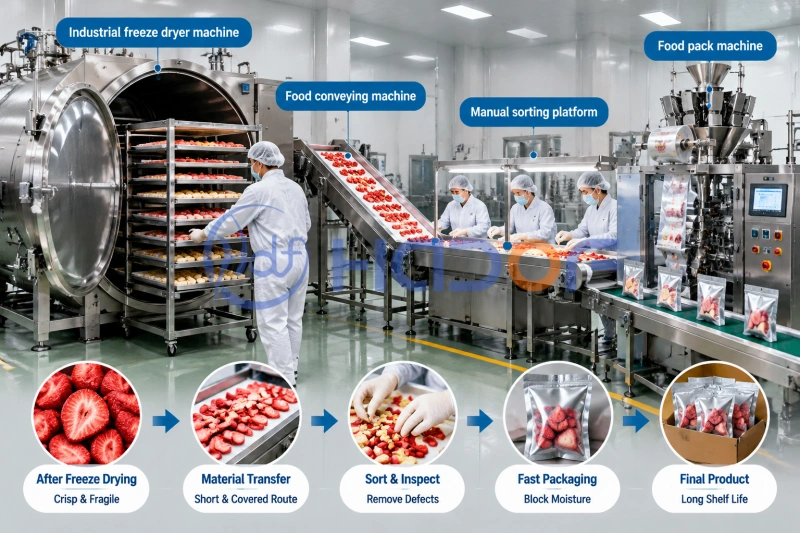
Freeze-dried food leaves the chamber in its most fragile state. Crisp, dry, and full of pores, it pulls moisture from the surrounding air within minutes. Every delay between the chamber door and the sealed bag quietly erodes that quality. A well-organized industrial freeze dryer machine therefore works best when packaging and material transfer follow one tight routine. Hadof designs the path from chamber exit to sealed case around your product, output, and plant layout.
Why Open-Air Waiting Steals Value
Freeze drying builds thousands of tiny pores inside each piece, while the surrounding structure stays light and brittle. Those pores then act like sponges as soon as humid air reaches the surface. Meanwhile, crisp granules soften, color deepens, and surface fats oxidize during a long wait. Every extra minute of exposure also narrows the margin that premium freeze-dried food depends on. Therefore, the goal is simple: move the load out, sort it, and seal it before the air does its damage.
Plan the Transfer Route From Chamber to Packager
Short straight routes beat long crossing ones, so layout decisions made early pay off for years. Trays or trolleys should roll from the chamber door to the sorting table without stairs, tight corners, or shared aisles. Delicate pieces ride the gentle belt of a food conveying machine instead of hand carts. Moreover, covered transfers shield the load from dust and drafts along the way. Hadof plans these routes together with the dryer and packager, so the distance between stations stays short.
Sort and Inspect Before the Bag
After that, sorting quality decides what your customer actually tastes. One manual sorting platform gives inspectors a bright, comfortable station to pull broken or discolored pieces before packing. Bright task lighting and stable bench height cut inspector fatigue across long shifts. Meanwhile, a steady feeding rhythm on the platform keeps inspectors from rushing. Besides, sorted loads let the packager run at a constant speed without stops. Defects caught here cost pennies, while defects found by a customer cost the account.
Package Fast to Block Moisture
Moisture is the only real enemy after drying, so the packaging step needs speed and barrier quality together. The food pack machine fills, seals, and codes each bag within moments of sorting. Nitrogen flushing or vacuum sealing adds another layer of protection for long sea shipments. Moreover, foil-laminated bags block vapor far better than plain film during months of storage. For export programs, carton sealing and desiccant placement add one more guard against humid transit. Seal integrity checks then close the loop before cases leave the plant.
Match Packaging and Material Transfer Speeds
A mismatch between stages creates queues, and queues create exposure. If the packager waits for a slow unload, finished batches sit open under ambient air. If the dryer waits for a busy packager, the next cycle starts late and the daily schedule slips. An industrial freeze drying equipment setup with a steady unload rate helps. Packaging and material transfer then move at one rhythm. Hadof sizes the unload, sorting, and packing capacity as one matched set.
Build the Freeze-Dried Food Line as One System
Every stage after drying either protects the freeze-dried food or spends it. Transfer, sorting, and packaging deserve the same engineering attention as the chamber itself. Then preparation, freezing, drying, and packing run to one rhythm. The fragile crisp structure thus survives all the way to the sealed case. For a customized solution, visit the Hadof freeze dryer homepage at https://www.freezehadof.com/.