

Namkeen, fried peanuts, broad beans, cashews, potato snacks, and other seasoned foods need stable flavor coverage without excessive powder loss, oil accumulation, or product breakage. A factory cannot solve these issues through drum rotation alone because surface oil, powder particle size, feed rate, product temperature, and seasoning residence time interact with each other. An oil-spray and powder dosing system for namkeen and peanuts allows snack processors to coordinate product movement, spice addition, optional oil application, drum speed, and discharge within one food production process. The correct settings depend on product shape, seasoning formula, surface condition after frying, and the hourly output of the complete snack line.
Why Does Oil Spray Matter Before Powder Dosing In A Namkeen Seasoning Line?
Dry seasoning needs a suitable surface condition if a processor wants spices to remain on the finished snack. A product that enters the drum with too little surface oil may release fine seasoning powder during conveying and packing. A product with too much free oil can develop seasoning clumps, uneven flavor spots, and unnecessary oil carryover. The seasoning page explains that some fried products need oil spraying before powder dosing and that warm fried food can hold powder more effectively after de-oiling.
A factory should therefore treat oil application as part of the food preparation system rather than as a separate cosmetic step. Namkeen may contain sev, flakes, pulses, nuts, or mixed components, so one oil-spray setting cannot suit every recipe. The process team needs to coordinate product feed rate, residual surface oil, spice fineness, and residence time before it establishes a repeatable food manufacturing recipe.
How Can A Continuous Seasoning Drum With Controlled Powder Application Improve Namkeen Consistency?
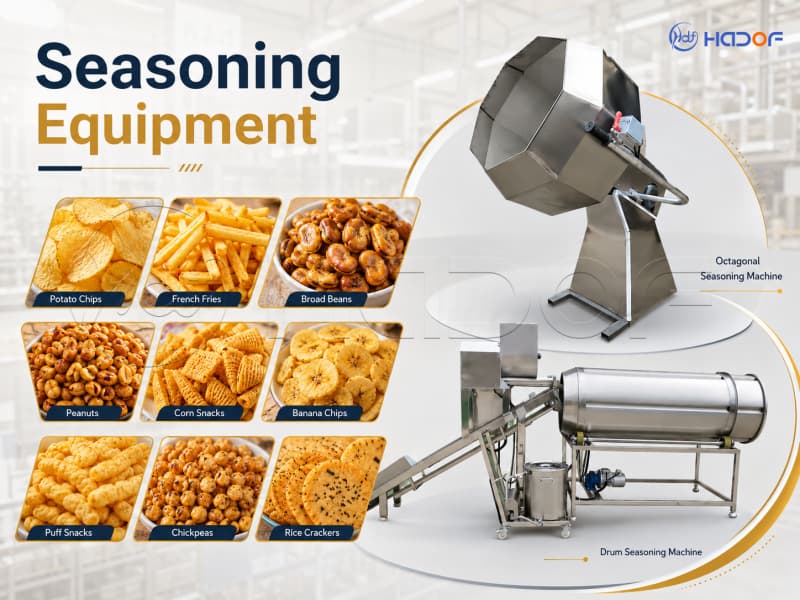
A continuous drum gives larger food factories a steady path from feeding to seasoning and discharge. Hadof’s rotary seasoning equipment moves products forward while the powder system adds seasoning at a stable rate. Operators can adjust drum angle and rotation speed to change retention time, while the seasoning system can combine powder dosing with oil application when the recipe requires both.
A continuous seasoning drum with controlled powder application helps processors reduce sudden seasoning concentration changes that can occur during irregular manual feeding. The food production team still needs consistent upstream flow because a stable powder rate cannot compensate for large changes in product mass. Namkeen processors should therefore coordinate the fryer, oil drainer, transfer conveyor, seasoning drum, cooling section, and packaging machine so every stage delivers a predictable load to the next machine.
How Should Fried Peanut Seasoning Equipment Balance Tumbling And Product Protection?
Fried peanuts and other nuts need enough movement to distribute salt, chili, barbecue seasoning, sugar blends, or compound flavor powders, but excessive tumbling can increase split kernels and broken pieces. The current seasoning equipment page identifies peanuts, broad beans, cashews, almonds, sunflower seeds, and mixed nuts as suitable materials and notes that adjustable speed helps processors manage collision, mixing time, and seasoning adhesion.
An automatic flavoring equipment system for fried peanuts and fine snacks can therefore use speed and residence-time control to match the mechanical strength of each product. Peanuts as a legume-based snack ingredient behave differently from thin sev or expanded snacks, so a mixed snack line may need separate recipes for each product. A food factory can then protect product shape while still achieving consistent flavor distribution.
When Should A Factory Choose Octagonal Seasoning Equipment Or A Continuous Rotary Drum?
A small or medium snack factory may need frequent flavor changes and smaller production runs, while a larger food manufacturer may prioritize continuous output. Hadof describes an octagonal seasoning machine for small and medium production and a rotary drum system for continuous industrial manufacturing. The octagonal design handles granular, flake, strip, block, and powder products, while variable speed changes residence time. The rotary system supports continuous feeding and discharge and currently includes standard models around 1,000 and 1,500 kg/h.
A variable-speed snack seasoning machine with oil spray gives a processor more control when recipes change between namkeen, peanuts, potato chips, banana chips, puffed snacks, or coated foods. The factory should choose batch or continuous equipment according to production volume, flavor-change frequency, cleaning schedule, and downstream packaging speed.
How Does A Vibrating Oil Drainer Improve Seasoning Adhesion Before Powder Application?
The seasoning stage performs more consistently when the upstream process delivers products with a stable amount of surface oil. A vibrating oil drainer before flavor application moves fried products across a vibrating screen while excess surface oil passes through the openings into a collection area. The equipment can connect the fryer with cooling, seasoning, and packaging stages, and its screen design can match different snack sizes.
This step helps the food handling process control the surface condition before seasoning. Namkeen with excessive oil may collect powder unevenly, while peanuts with inconsistent surface oil may show flavor variation from batch to batch. A factory can therefore coordinate de-oiling time, transfer distance, product temperature, oil spraying, and powder dosing instead of asking the seasoning drum to correct unstable incoming material.
What Information Should A Snack Factory Provide For An Automatic Seasoning Line Quotation?
A seasoning equipment quotation should reflect actual food production conditions. The buyer should define snack type, hourly output, particle size, product temperature after frying, seasoning powder characteristics, whether the recipe needs oil spraying, required automation level, available voltage, workshop layout, and upstream and downstream machine widths. Hadof states that final seasoning configuration depends on capacity, material, powder dosing, oil spraying, voltage, and customization, and the equipment can connect with fryers, vibrating de-oiling machines, cooling conveyors, elevators, and packaging systems.
It covers multiple frying and supporting stages for food manufacturing projects. A snack producer can therefore evaluate seasoning machinery together with frying, oil management, cooling, conveying, and packaging rather than selecting the flavoring machine separately. Buyers who need to compare automation levels can review available seasoning machine configurations before matching equipment with namkeen, peanuts, beans, chips, or other fried snacks.
In conclusion, stable namkeen and peanut seasoning depends on controlled product feed, surface oil, powder dosing, drum speed, retention time, and upstream de-oiling. Small factories may prefer flexible batch seasoning, while higher-volume plants may need continuous rotary equipment with coordinated powder and oil application. If you have interests in seasoning systems for namkeen, fried peanuts, beans, potato snacks, or mixed fried foods, you can learn more about: